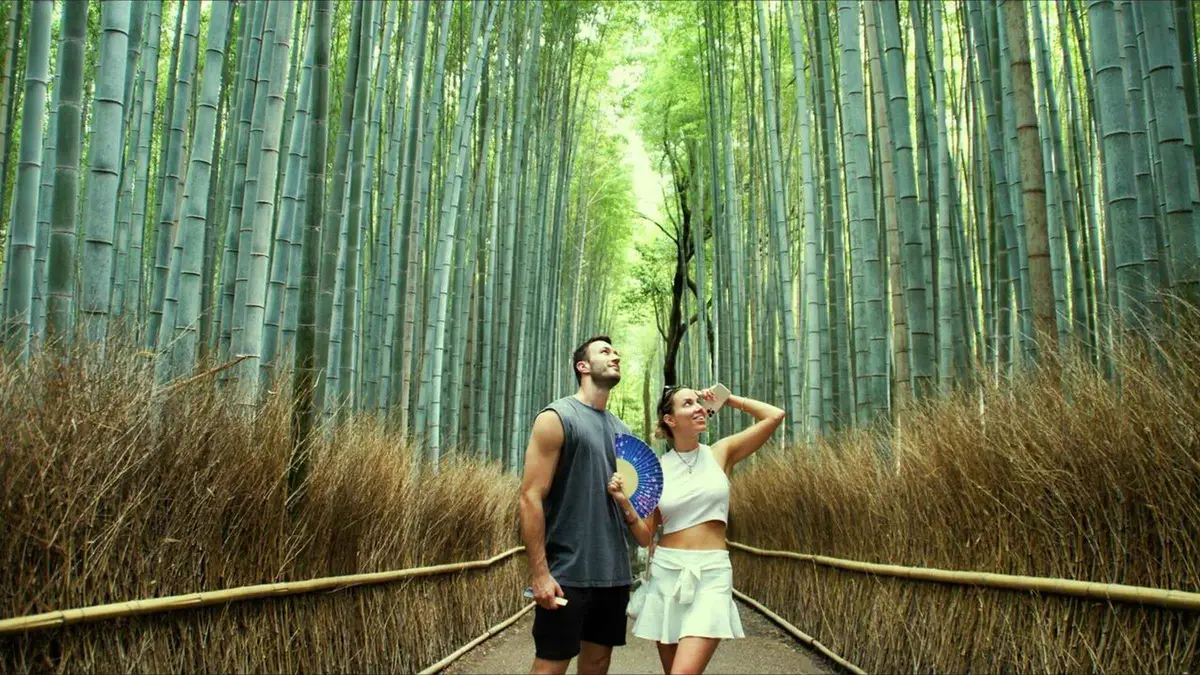
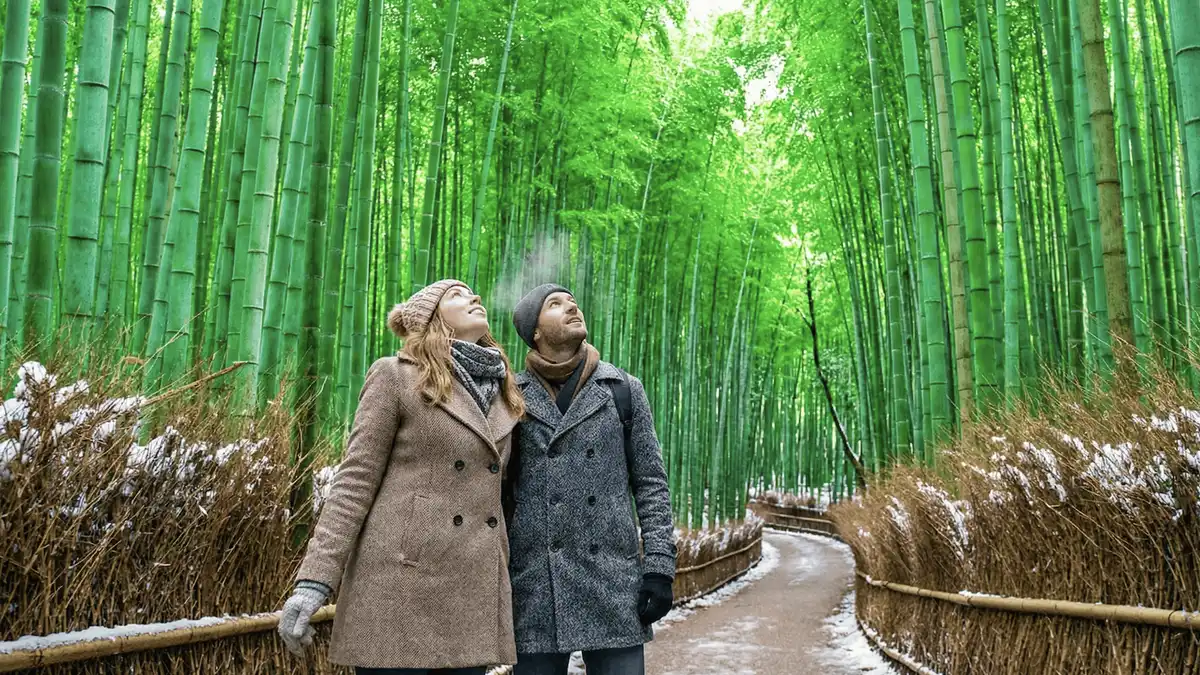
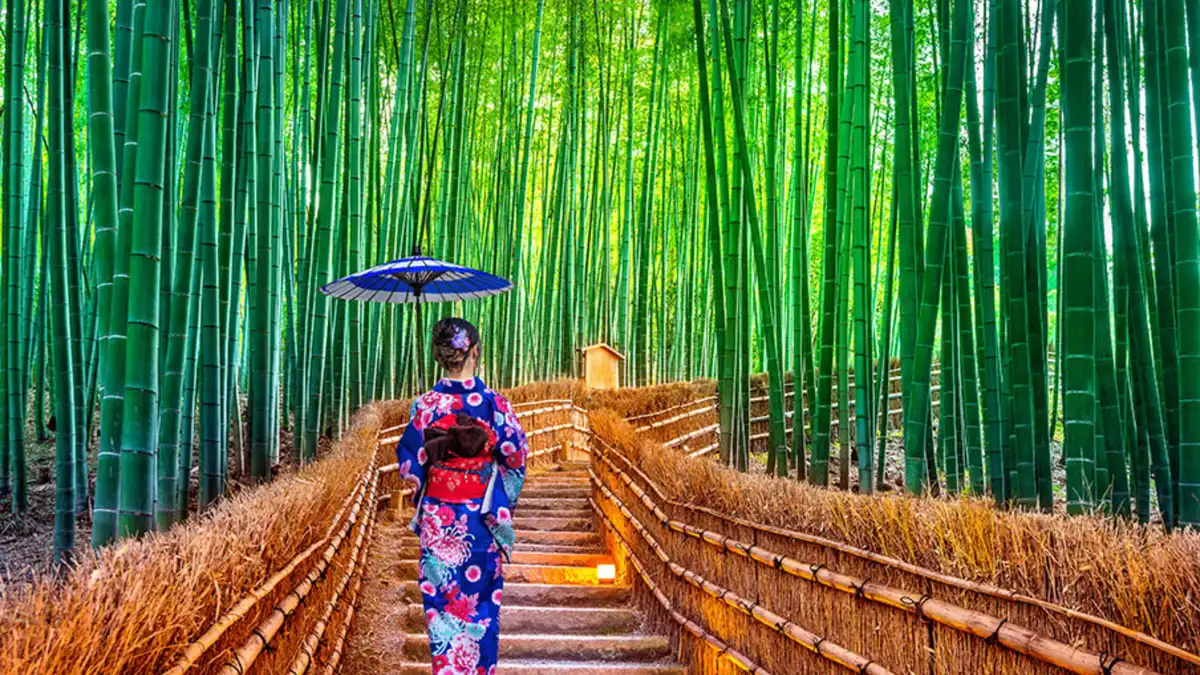
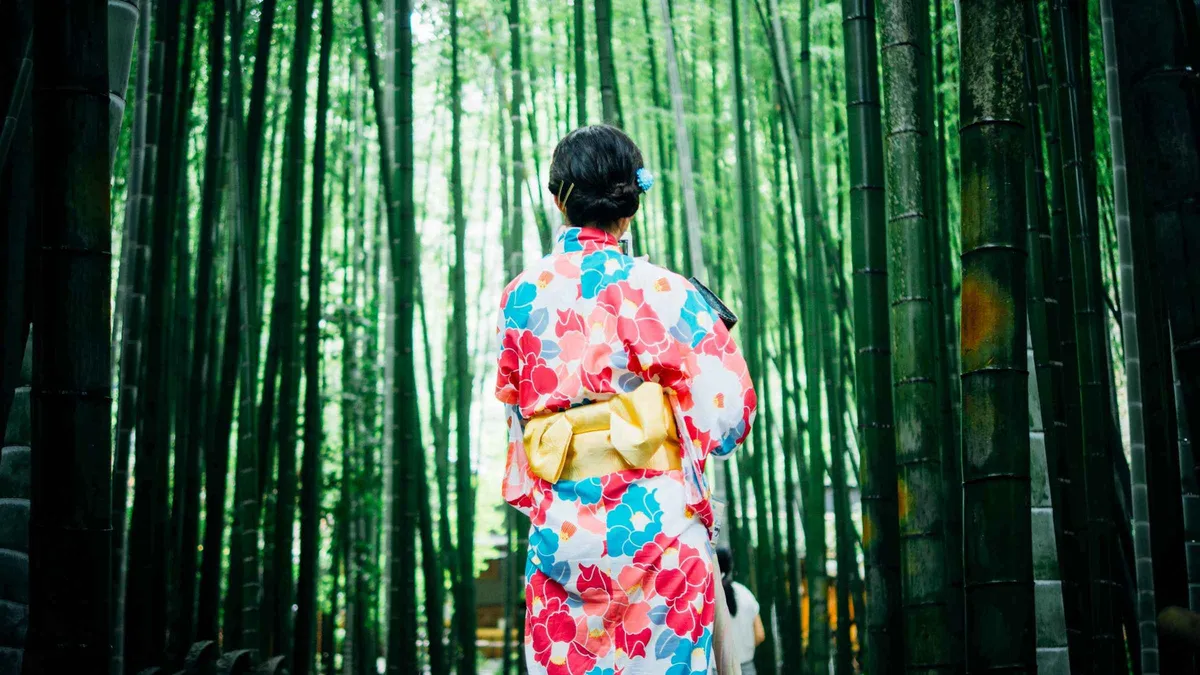
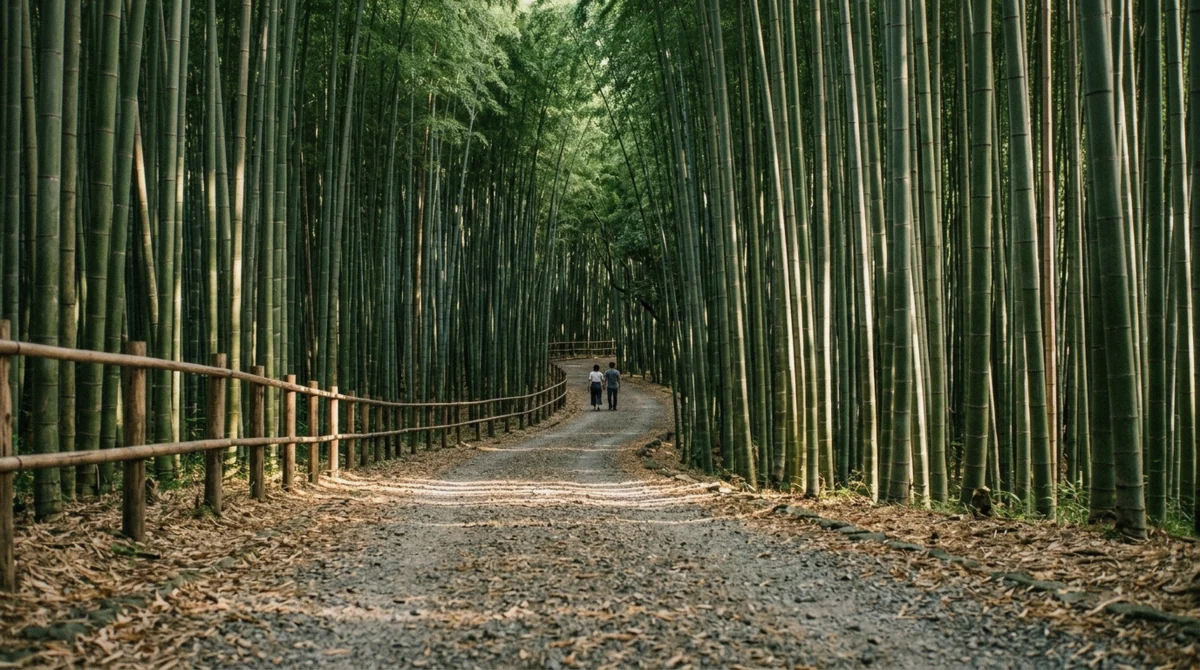
Morning light raking through the green culms of the Arashiyama Bamboo Forest path in Kyoto, Japan
Arashiyama Bamboo Forest
Sixteen minutes west of Kyoto Station, the Arashiyama Bamboo Forest costs nothing to walk and has no gate to close. Arrive at the right hour and you get it almost to yourself.
The Arashiyama Bamboo Forest is a public path through a mōsō bamboo grove in the Ukyo Ward of western Kyoto, open 24 hours a day with no entrance fee and no ticket of any kind. Walking the main path end to end takes 10–15 minutes, which surprises most first-time visitors, so plan the grove as one stop inside an Arashiyama morning rather than the whole outing. Before 8:30 the path is quiet; by 10 it is shoulder to shoulder.
Key takeaways
Entry is free and there is no ticket office, gate or opening hour to work around.
Bring cash: Iwatayama Monkey Park charges ¥800 (about $5) at the gate and takes no cards.
Free cancellation 24h
Reserve now, pay later
Licensed local guides
Temple entry included
¥0Entrance feeCharging stopped in 2015
16 minutesKyoto Station to Saga-ArashiyamaJR Sagano Line, ¥240
8:30 amBeat the crowds byTuesday to Thursday are quietest
6 sightsWithin a 15-minute walkTemple, villa, shrine, bridge, macaques, tram art
most booked
The Walk Most People Book
Arashiyama Bamboo, Temple and Okochi-Sanso Walk — with Monkey Park or Sake Brewery
★★★★★★★★★★4.9(938 reviews)
The most-reviewed guided walk on this page, run by Japan Tour Adventure. It is the only one that includes the ¥1,000 Okochi-Sanso Garden ticket, and after the grove and Tenryu-ji you pick your ending: Option A crosses Togetsukyo Bridge to the Iwatayama Monkey Park (ticket included), Option B takes the train one stop out to a local lunch and a sake tasting at Tanzan Brewery. Group or private rates. Meet by the map below the north-side stairs at JR Saga-Arashiyama Station; the guide wears a red JTA polo. Bring cash, since the monkey park gate does not take cards.
Duration
5 to 5.5 hours, morning start
Meeting Point
By the map below the north-side stairs at JR Saga-Arashiyama Station, guide in a red JTA polo
Included
Okochi-Sanso Garden, Tenryu-ji and Iwatayama Monkey Park tickets, green tea, souvenir photos
Morning departures fill first in cherry blossom season and again through the November colour. Pick a date to see which start times are still open and the price in your own currency.
Six guided options, all starting inside Arashiyama rather than at a Kyoto hotel. What separates them is the hour they start, whether the monkey park and Okochi-Sanso tickets are in the price, and whether you walk or ride.
from $86Most Booked — 4.86★, 938 Reviews
Arashiyama Bamboo, Temple and Okochi-Sanso Walk — with Monkey Park or Sake Brewery
★★★★★★★★★★4.9(938 reviews)· 5 - 5.5 hours
The most-reviewed guided walk on this page, run by Japan Tour Adventure. It is the only one that includes the ¥1,000 Okochi-Sanso Garden ticket, and after the grove…
Okochi-Sanso Garden entry included: the ¥1,000 villa at the top of the grove
Tenryu-ji and Iwatayama Monkey Park tickets included (Option A)
Option B swaps the monkeys for a local lunch and Tanzan Brewery sake tasting
Arashiyama Bamboo Grove, Tenryu-ji, Matcha and the Monkey Park
★★★★★★★★★★4.8(601 reviews)· 4 hours
Traveling Tokyo's four-hour loop, and the one that packs the most paid entries into a single ticket: Tenryu-ji, a cup of Uji matcha and the monkey park are…
Tenryu-ji entry, one Uji matcha drink and monkey park admission all included
45 minutes inside the bamboo grove, the longest stop of any tour here
Nonomiya Shrine and Togetsukyo Bridge on the same loop
Meets at Tully's Coffee, Randen Arashiyama Station
Arashiyama Unveiled — Bamboo Grove, Tenryu-ji, Matcha and Macaques
★★★★★★★★★★4.9(49 reviews)· 4 hours
The cheapest guided version of the classic Arashiyama circuit, and the highest-rated of the four-hour walks. Same spine as the tours above (Tenryu-ji's Zen garden, the bamboo path…
Cheapest guided walk here that still includes Tenryu-ji and the monkey park
One matcha drink included
Small groups that often turn out to be near-private
Tenryu-ji Zen garden, bamboo path, Nonomiya Shrine, Togetsukyo Bridge
Arashiyama Walking Tour: Bamboo Grove, Kimono Forest and Monkey Park
★★★★★★★★★★5.0(8 reviews)· 3 hours
A newer, shorter three-hour walk with a perfect score from its first handful of travellers. It is the only tour here that builds the Kimono Forest, the 600-plus…
Only tour here that walks the Kimono Forest's 600 illuminated pillars
Three hours, the shortest full circuit of the district
Morning (9:30) or afternoon (13:00) departure
Bamboo grove, Tenryu-ji garden, Togetsukyo Bridge, Iwatayama Monkey Park
The prices below are per adult on GetYourGuide, checked on 3 August 2026. Read the admissions row first: two of these tours look cheap until you pay ¥500 at Tenryu-ji and ¥800 at the monkey park yourself.
Prices move with the season and with the yen. Every listing here offers free cancellation up to 24 hours ahead.
Arashiyama by the Numbers
What a day around the grove actually costs, in yen and at the 3 August 2026 rate of ¥157 to the dollar.
🎋¥0Bamboo grove entryFree since 2015, open around the clock
⛩️¥500Tenryu-ji gardenAbout $3.20, plus ¥300 for the buildings
🍵¥1,000Okochi-Sanso VillaAbout $6.40, matcha and a sweet included
🐒¥800Iwatayama Monkey ParkAbout $5.10, cash only, ¥400 for children
🚂¥880Sagano Romantic TrainAbout $5.60 for the 25 minute ride to Kameoka
🌉155 mTogetsukyo BridgeHeian-period crossing, rebuilt in the 1930s
Arashiyama Bamboo Forest: The Practical Guide
Everything below was checked in August 2026. Yen prices carry a dollar conversion at ¥157 to the dollar, the rate on 3 August 2026.
What the grove actually is
The Arashiyama Bamboo Forest, called Sagano by locals and older maps, is a working grove of mōsō bamboo (Phyllostachys edulis) with a public path cut through it in the Sagaogurayama Tabuchiyamacho neighbourhood of Ukyo Ward, western Kyoto, at 35.0168°N, 135.6716°E. The culms run 15 to 20 metres up and lean over the path so the light arrives green and moving. Japan's Ministry of the Environment put the sound of wind through these stalks on its list of the 100 Soundscapes of Japan, which tells you what the place is meant to be and, on a Saturday at noon, what it no longer is.
There is no entrance fee. There is no ticket, no booth and no fence: the path is a public right of way that happens to run through bamboo, so it is open 24 hours a day, every day of the year. A small charge existed before 2015 and has since gone. Anyone selling you an Arashiyama Bamboo Forest ticket is selling you a guided tour, a rickshaw ride or a seasonal night event, never admission to the grove itself.
The main path at 7:40 on a weekday morning. Two hours later the same frame holds forty people.
The walk itself, and why it is shorter than you think
The main path is the length of a few city blocks. Walking it end to end takes 10–15 minutes at a slow pace, and that is the single fact that decides whether you leave happy. Travellers who budget half a day for the bamboo and nothing else come away calling it overrated. Travellers who treat it as twenty minutes inside a four-hour Arashiyama morning rarely do.
The route bends in an L. You enter from the south near Nonomiya Shrine or from the north gate of Tenryu-ji, climb gently, and reach the top where the entrance to Okochi-Sanso Villa faces you. Most visitors turn around there. Keep going instead: cross the Sagano railway line at the level crossing and the second stretch of bamboo is markedly quieter, with the trains giving the scene the look of an anime frame. Photographers who wait two minutes for a gap in the walkers get their shot on this side.
Getting there from Kyoto Station
Three routes work, and the difference between them is about six minutes and a hundred yen.
The JR Sagano Line (also signed San-in Line) runs from Kyoto Station to Saga-Arashiyama in about 16 minutes for ¥240, roughly $1.50, and the grove is a 10-minute walk from that station. This is the fastest option and the one covered by a Japan Rail Pass. The Randen tram, run by Keifuku, ends at Arashiyama Station, a flat ¥250 fare and a 15-minute walk to the grove; get there by taking the subway to Uzumasa Tenjingawa and changing. City buses 28 and 93 also run out here and take 45 minutes in traffic, which is why the train wins.
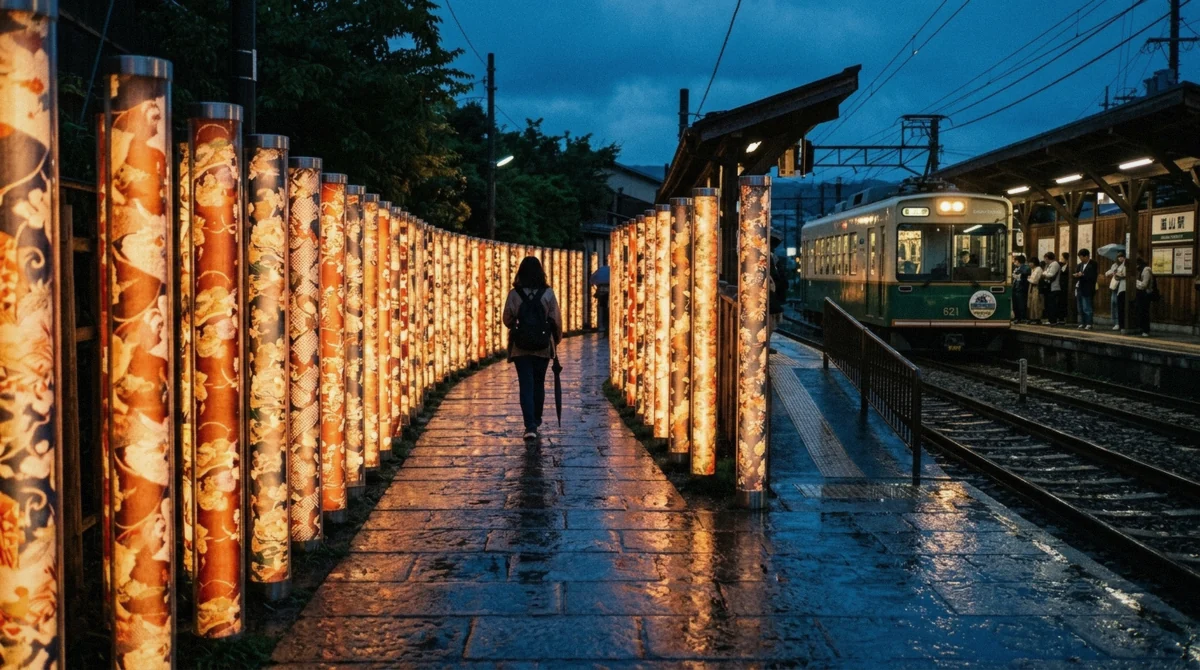
Arriving by Randen has one advantage: the platform is wrapped in the Kimono Forest, an installation of more than 600 pillars sleeved in kimono fabric that light up after dark. It costs nothing to walk through and takes five minutes; the 600 lit pillars of the Kimono Forest have their own page.
JR Sagano Line, Kyoto Station to Saga-Arashiyama: 16 minutes, ¥240, then a 10-minute walk
Randen tram to Arashiyama Station: flat ¥250, 15-minute walk, Kimono Forest on the platform
City bus 28 or 93: about 45 minutes, ¥230, useful only if you are staying on the route
Taxi from central Kyoto: 30 to 40 minutes and ¥3,500 or so, worth it only before the first train
When to go: the hour matters more than the season
Arrive before 8:30 in the morning and the path is close to empty. That window has narrowed as the district's popularity has grown, and by 10 am tour groups arrive in a steady line that does not thin until late afternoon. Tuesday, Wednesday and Thursday are the quietest days of the week. The last hour before sunset empties out again as coach groups leave, although the light under the canopy fades early.
The two peak crowd windows are late March to mid-April for cherry blossom and mid-November for autumn colour, when Arashiyama absorbs a large share of Kyoto's visitors. Bamboo is evergreen, so the grove itself looks much the same in February as in August. What changes around it is the maple colour on the hillsides, the temperature, and the number of people in your photographs. Winter mornings after snow are the local photographers' pick and the least crowded time of the year.
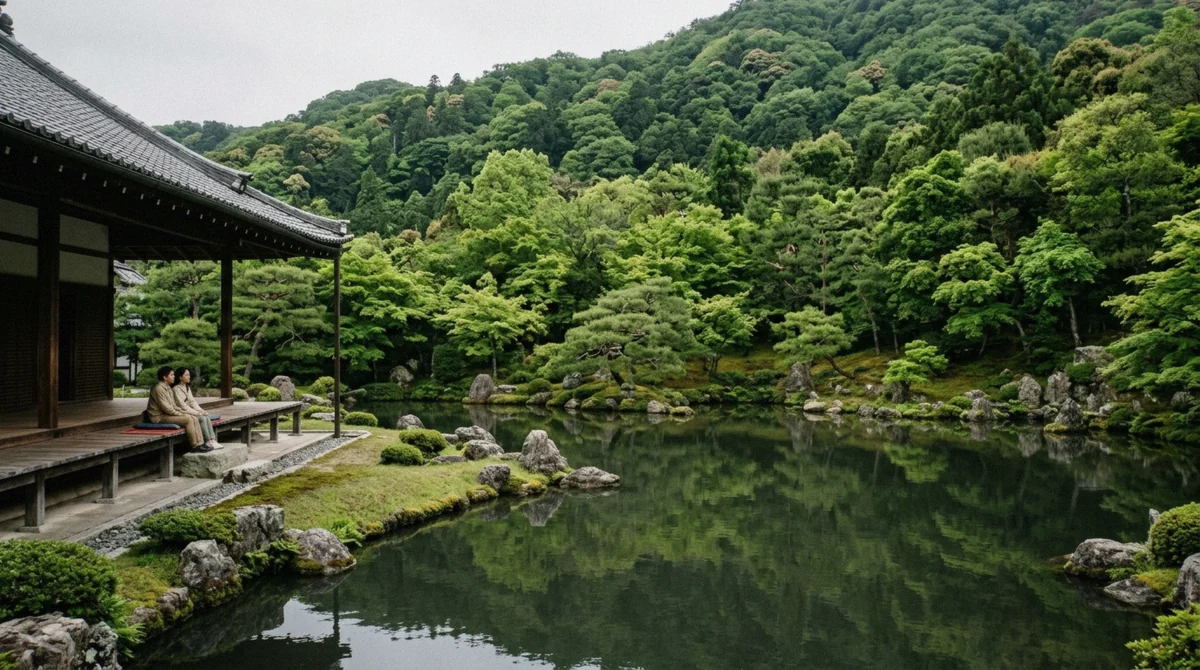
Tenryu-ji's Sogenchi garden. Its north gate opens straight into the bamboo, which is the smartest way to enter.
What everything costs around the grove
The bamboo is free. The good things next to it are not, and all of them are cheap by Kyoto standards.
Tenryu-ji, a UNESCO World Heritage site and headquarters of the Rinzai school of Zen, charges ¥500 for the Sogenchi garden and ¥300 more to enter the buildings, open 8:30 to 17:00 with last admission at 16:50. Buy the garden ticket and leave through the north gate: it opens directly into the grove and skips the queue at the southern entrance. Okochi-Sanso Villa, the mountainside estate built by silent film star Okochi Denjiro, sits at the top of the path and charges ¥1,000, which includes matcha and a sweet at its teahouse, open 9:00 to 17:00. Keep the ticket stub or you will not get the tea.
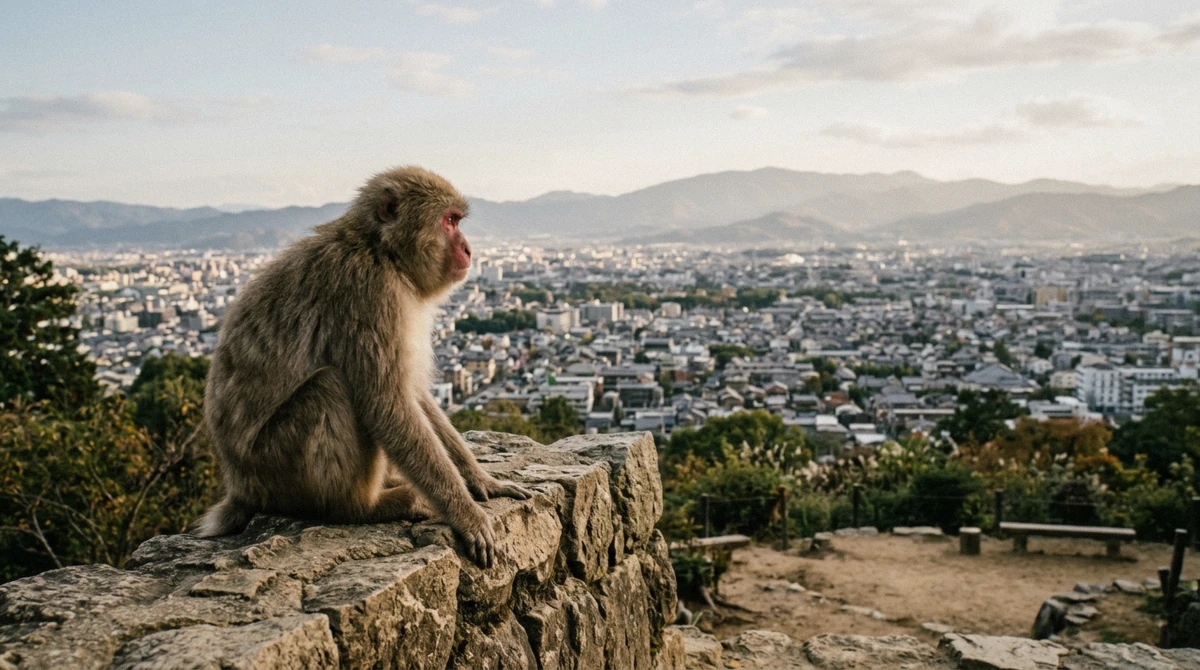
Across Togetsukyo Bridge, Iwatayama Monkey Park charges ¥800 for adults and ¥400 for children aged 4 to 15, cash only at the gate, and asks for a 15–20 minute uphill hike before you meet any of its 120 wild Japanese macaques, and our full guide to Arashiyama Monkey Park covers the climb and the cash-only gate. Hours are 9:00–16:30 from 15 March to 30 September and 9:00–16:00 from 1 October to 14 March. The view over Kyoto from the feeding hut is the reason to climb even if the monkeys keep their distance, and what the ¥800 buys is worth reading before you cross the bridge.
Rickshaws, photographs and the path you cannot walk
One stretch of the grove, the one with bamboo pressing in on both sides that appears in most of the famous photographs, is a private lane reserved for rickshaw passengers. Walkers cannot enter it. Ebisuya runs the service and charges ¥9,000 for one passenger or ¥10,000 for two on its 30-minute Bamboo Forest course, about $57 and $64, with the drivers doubling as photographers and guides. Whether that is worth it depends on how much the picture matters to you.
For everyone else the rules are simple and mostly about other people. Tripods block a narrow path and get you asked to move on busy days. Drones are not permitted. The bamboo is living property of the temples and residents whose houses back onto the path, and carving initials into culms has become enough of a problem that signs now name it in four languages. Rain helps more than it hurts here: the canopy holds most of it off, the greens saturate, and half the day-trippers stay in central Kyoto.
The Kimono Forest at Randen Arashiyama Station lights up at dusk and costs nothing to walk through.
The grove at night, and the light-up question
The path has no permanent lighting and no gate, so you can walk it at night, but you will be walking in the dark with a phone torch and the bamboo will read as a black wall. The event people remember is the Arashiyama Hanatouro, a winter light-up that ended in 2021 after two decades. Ticketed night illuminations have since returned as limited seasonal runs: in October 2025 the grove was lit from 18:00 to 21:00 with last entry at 20:30 and a ¥1,500 ticket, about $9.60. Check the current year's dates before you plan an evening around it, because the event has run under different names and does not repeat on a fixed schedule.
One consolation if you miss it: the Kimono Forest at Randen Arashiyama Station is lit every evening and free, and the Katsura riverbank around Togetsukyo Bridge keeps its lamps on late.
Making a day of it, and where to eat
The grove is 20 minutes of a good Arashiyama day. The rest fills itself: Tenryu-ji before 9, the bamboo, Okochi-Sanso for the tea and the view over the city, then down to the river. The Sagano Romantic Train up the Hozugawa gorge leaves Torokko Saga for Torokko Kameoka every hour from 9:02 to 16:02, takes 25 minutes along the Hozugawa gorge, and costs ¥880 for adults and ¥440 for children. Every seat is reserved and online sales open a month ahead at midnight, so the autumn departures go quickly. Many travellers pair it with the Hozugawa river boat back down.
Eat early. Most Arashiyama restaurants close between 16:00 and 18:00, and the district empties in the evening more thoroughly than any other part of Kyoto. Yudofu, simmered tofu in dashi, is the local speciality and the temple restaurants serve it from around ¥3,000.
If the crowds beat you: quieter bamboo near Kyoto
Two alternatives come up again and again from people who live here. Jizo-in, a small temple in western Kyoto known as the Bamboo Temple, has a bamboo approach and a moss garden and receives a fraction of Arashiyama's visitors. Rakusai Bamboo Park, a municipal park about 20 minutes away by bus, has several kilometres of bamboo trails, a research grove of rare species, and free entry.
Neither has the scale of the Sagano corridor. What they have is silence, which is the thing most people came for and half of them do not find. Walk the famous path early, then spend the afternoon somewhere no one photographs.
Month by Month at the Bamboo Grove
The bamboo is evergreen, so what changes is the weather, the colour on the hillsides, and how many people share the path with you.
JanuaryColdest, emptiest2-9°C. Snow on the culms two or three mornings a year and the photograph of a lifetime if you catch one.
FebruaryQuiet, plum blossom3-10°C. The plum trees at nearby temples open late in the month. Weekday mornings are near empty.
MarchBuilding up6-14°C. Calm until the third week, then cherry blossom pulls the city west and the path fills.
AprilPeak crowds11-20°C. Cherry blossom on the Arashiyama hillsides. Arrive by 7:30 or accept the queue.
MayBest all-rounder16-25°C. Fresh growth, mild air, crowds off their April peak. New bamboo shoots visible along the path.
JuneRainy season20-28°C. The tsuyu rains saturate the greens and thin the crowds. The canopy keeps most of the drizzle off.
JulyHot and humid24-33°C. Walk before 9 or after 17:00. Kyoto's summer heat is genuinely punishing by midday.
AugustHottest25-34°C. Same rule as July. Guides sometimes hand over the monkey park climb rather than lead it in this heat.
SeptemberTyphoon watch21-30°C. Heat eases late in the month. Occasional typhoon closures on the Sagano Romantic Train.
OctoberComfortable15-23°C. The best month for walking the whole district. Night illumination events have run in October since 2025.
NovemberAutumn peak9-18°C. Maple colour brings the second crowd surge of the year. Book the scenic train weeks ahead.
DecemberWinding down4-12°C. Colour gone by the second week, crowds with it. Cold, clear mornings and short daylight.
Temperatures are typical daily lows and highs for Kyoto. The grove itself stays green year round.
The Walk, End to End
Ten minutes of unedited walking through the grove, which is a fair way to judge both the scale and the crowds before you commit a morning to it.
Where the Grove Is, and Which Station to Use
The grove sits at 35.0168°N, 135.6716°E in Sagaogurayama Tabuchiyamacho, Ukyo Ward. JR Saga-Arashiyama is the closer station at 10 minutes on foot; Randen Arashiyama is 15 minutes and delivers you through the Kimono Forest.
JR Saga-Arashiyama Station10-minute walk, 16 minutes and ¥240 from Kyoto Station
Randen Arashiyama Station15-minute walk, flat ¥250, Kimono Forest on the platform
Tenryu-ji north gateOpens straight into the grove, ¥500 for the garden
Okochi-Sanso VillaTop of the path, ¥1,000 with matcha
Iwatayama Monkey ParkAcross Togetsukyo Bridge, then a 15-20 minute climb
The Route, Stop by Stop
An order that works: temple first while it is empty, bamboo second, villa third, then down to the river. Ninety minutes at a walking pace, longer if you stop for tea.
JR Saga-Arashiyama StationArrive on the 16-minute train from Kyoto Station. Turn right out of the gates and follow the crowd downhill for 10 minutes.
Tenryu-jiGates open at 8:30. Pay ¥500 for the Sogenchi garden, walk it in 30 minutes, then leave by the north gate.
Nonomiya ShrineThe southern entrance to the grove. Imperial princesses purified themselves here before Ise, and it appears in The Tale of Genji.
The main bamboo path10–15 minutes uphill through the corridor. The rickshaw lane on the right is private; the walking path is the one everyone shares.
The railway crossingCross the Sagano line at the top for a second, quieter stretch of bamboo that most visitors never reach.
Okochi-Sanso Villa¥1,000 at the top of the path buys the gardens, the view over Kyoto, and matcha with a sweet at the teahouse.
Reverse the order after 15:00 to walk against the flow of the coach groups.
What Travellers Said After Walking It
Verified reviews left on GetYourGuide by people who booked the guided walks on this page.
★★★★★★★★★★
Jack was an amazing tour guide. He has a vast knowledge of the Japanese culture. He took plenty of photos where the back drop wasn't with crowds of people but beautiful views that my family will treasure.
Mali was excellent, had a broad knowledge of history and customs, and answered everyone's questions. The forest was amazing but busy, the temples lovely, but beware of the hike up the mountain.
We thoroughly enjoyed our early access walking tour of the bamboo forest and Tenryu-ji Temple. Our guide, Ken, provided excellent descriptions of the sights and took some beautiful photos of my wife and me.
It was really great and we had the best time. Our guide Ali was a very nice guy who took all the time and took beautiful pictures of us and the environment.
Reviews are quoted from verified bookings on GetYourGuide and lightly trimmed for length. Ratings and counts on this page were checked on 3 August 2026.
The view from the feeding hut at the top of Iwatayama, a 15–20 minute climb from the bridge. Entry is ¥800, cash only.
How to Get This Right
Set the alarm, not the budget
Nothing you can pay for improves this place as much as arriving before 8:30. The tours that cost the most are not the ones that give you an empty path; the earliest one is.
Enter through Tenryu-ji
The temple's north gate opens into the grove partway along, which bypasses the bottleneck at the southern entrance. The ¥500 garden ticket earns its money on that alone.
Do not stop at the top
Most visitors turn back at Okochi-Sanso. Cross the railway line instead and the second stretch of bamboo is quieter, with the trains cutting through the frame.
Carry cash
Iwatayama Monkey Park takes ¥800 in cash at the gate and nothing else. Several small teahouses along the path are the same.
Book the guide for the context
You do not need a ticket to walk here, so what a guide sells is the history, the side lanes and the timing. The walks with Okochi-Sanso and monkey park entry included cover most of their own cost.
Give the district the whole morning
The bamboo is 15 minutes. Tenryu-ji, the villa, the bridge, the macaques and the scenic train are what turn it into a day worth the trip out west.
Everything Within a 15-Minute Walk
Fees and hours checked on 3 August 2026. Dollar figures use ¥157 to the dollar.
⛩️Tenryu-ji2 minUNESCO Zen temple with the Sogenchi pond garden. ¥500 garden, ¥300 more for the buildings, 8:30 to 17:00. Its north gate opens into the grove.
🍵Okochi-Sanso VillaAt the top of the pathFilm star's mountainside estate, ¥1,000 including matcha and a sweet, 9:00 to 17:00. Best view over Kyoto in the district.
🦊Nonomiya ShrineAt the south entranceFree. Ancient purification site for imperial princesses bound for Ise, and a setting in The Tale of Genji.
🌉Togetsukyo Bridge8 minFree. The 155 metre Moon Crossing Bridge over the Katsura River, Heian in origin and rebuilt in the 1930s.
🐒Iwatayama Monkey Park15 min plus the climb¥800 adults, ¥400 children, cash only. 9:00–16:30 in summer, 9:00–16:00 from October. Over 120 wild macaques.
👘Kimono Forest15 minFree. More than 600 pillars of kimono fabric around the Randen Arashiyama tram platform, lit after dark.
Questions People Ask Before They Go
Is Arashiyama Bamboo Forest worth visiting?
Yes, with one condition: go early and treat it as part of a morning in Arashiyama rather than a destination in itself. The path takes 10–15 minutes to walk, so anyone expecting a forest to spend hours in leaves disappointed, and that accounts for most of the negative reviews you will read. At 8 in the morning, with the light coming through sideways and no one else on the gravel, it earns its reputation. At 11 on a November Saturday it is a queue with bamboo on either side. It costs nothing, so the only thing you risk is the hour.
Is it free to enter Arashiyama Bamboo Grove?
It is free. There is no entrance fee, no ticket and no gate, and there has been no charge since 2015. The paid things sit around the grove rather than inside it: Tenryu-ji at ¥500, Okochi-Sanso Villa at ¥1,000, Iwatayama Monkey Park at ¥800 in cash. If a site is selling an Arashiyama Bamboo Forest ticket, look closely, because what is on sale is a guided walk, a rickshaw ride or a seasonal night event.
How long does it take to walk through Arashiyama Bamboo Forest?
About 10–15 minutes end to end at a slow pace, longer if you stop for photographs and are waiting for gaps in the crowd. Add the second section beyond the railway crossing and you are still under half an hour. Budget 90 minutes for the grove plus Tenryu-ji and Nonomiya Shrine, or half a day for the whole district including the monkey park and the bridge.
What is the best time to visit Arashiyama Bamboo Forest?
Before 8:30 in the morning, on a Tuesday, Wednesday or Thursday. That combination gets you closest to an empty path. The last hour of daylight is the second-best window because the coach groups have gone. Avoid late March to mid-April and mid-November if crowds bother you, since cherry blossom and autumn colour bring Kyoto's heaviest visitor numbers out here. If you cannot manage an early start on your own, the 2.5-hour early access walk is built around exactly that window.
Can you visit the bamboo forest at night?
The path is open 24 hours and unlit, so you can walk it at night with a torch, though the bamboo mostly reads as a dark wall. The Hanatouro winter light-up that people remember ended in 2021. Ticketed night illuminations have returned as short seasonal runs since 2025, priced around ¥1,500 with entry from 18:00 to 21:00, and the dates change each year. The Kimono Forest at the Randen station is lit every evening and costs nothing.
How do you get to Arashiyama Bamboo Forest from Kyoto Station?
Take the JR Sagano Line to Saga-Arashiyama, about 16 minutes for ¥240, then walk 10 minutes. The alternative is the Randen tram to Arashiyama Station, a flat ¥250 and a 15-minute walk, reached by subway to Uzumasa Tenjingawa. Buses 28 and 93 take about 45 minutes. Guided walks meet at one of the two stations, so you make your own way out either way.
Do I need a guide to see the bamboo forest?
No. The path is public and self-guiding, and plenty of people walk it with nothing but a phone. What a guide adds is entry tickets bundled at no markup, the history behind Nonomiya and Tenryu-ji, and someone who knows which lane to take when the main path clogs. The 5-hour circuit includes the Okochi-Sanso, Tenryu-ji and monkey park tickets, which is roughly ¥2,300 of admissions, and the four-hour walks cover temple entry, matcha and the monkey park.
Can you ride a rickshaw through the bamboo grove?
Yes, and it is the only way onto the private lane where the bamboo closes in on both sides, the stretch behind most of the famous photographs. Ebisuya charges ¥9,000 for one passenger and ¥10,000 for two on the 30-minute Bamboo Forest course, roughly $57 and $64. Drivers stop for photographs and narrate as they pull.
Is there a quieter alternative to the Arashiyama bamboo?
Two, both in western Kyoto. Jizo-in, known as the Bamboo Temple, has a bamboo approach and a moss garden with a fraction of the visitors. Rakusai Bamboo Park has kilometres of trails through several bamboo species and free entry, about 20 minutes away by bus. Neither matches the Sagano corridor for scale, and both beat it for quiet.
How much should I budget for a day in Arashiyama?
Around ¥3,500 per person, near $22, covers the return train from Kyoto Station, Tenryu-ji, Okochi-Sanso with its matcha and the monkey park. Add ¥880 each way for the Sagano Romantic Train, ¥3,000 or so for a yudofu lunch, and remember that most restaurants here close between 16:00 and 18:00. A guided walk at $51 to $108 replaces most of the admissions with a single booking.
What else is worth doing in Arashiyama besides the bamboo?
Three things carry a half day on their own. Arashiyama Monkey Park is ¥800 in cash and a 160 metre climb to a hilltop troop of macaques with the best view in the district. The Sagano Romantic Train runs 25 minutes up the Hozugawa gorge for ¥880, every seat reserved. The Kimono Forest at the Randen station is free and worth timing for dusk, when its 600 pillars light up.
Six guided walks through the grove, from a 2.5-hour early start to a five-hour circuit with the villa and the macaques.
Free cancellation up to 24 hours before, no payment today
 Arashiyama Bamboo Forest
 from $86
Most Booked — 4.86★, 938 Reviews
from $86
Most Booked — 4.86★, 938 Reviews