 Arashiyama Bamboo Forest
Okochi Sanso Villa: The ¥1,000 Nobody Regrets
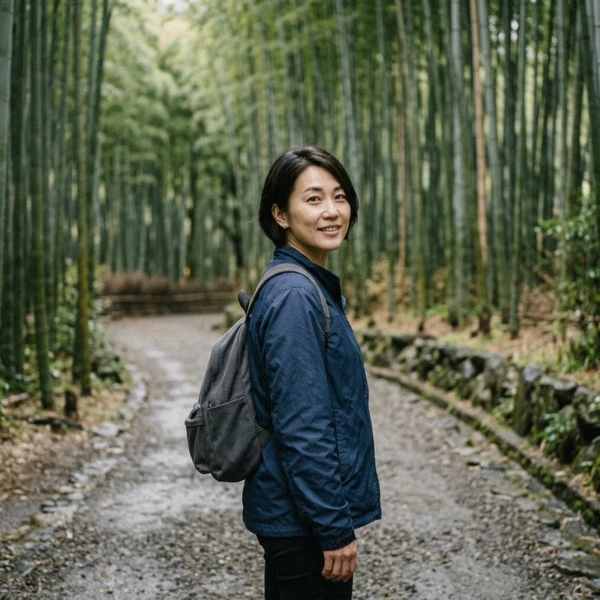
Okochi Sanso Villa is where the bamboo path ends and almost everyone turns around. That is the whole opportunity: a film star's private estate on the slope of Mount Ogura, built over thirty years, with two viewpoints, a teahouse and a moss garden, and a ¥1,000 ticket that keeps out the crowd standing thirty metres away in the Arashiyama Bamboo Forest. The price includes a bowl of matcha. It is the single best-value hour in the district and the one most visitors walk straight past.
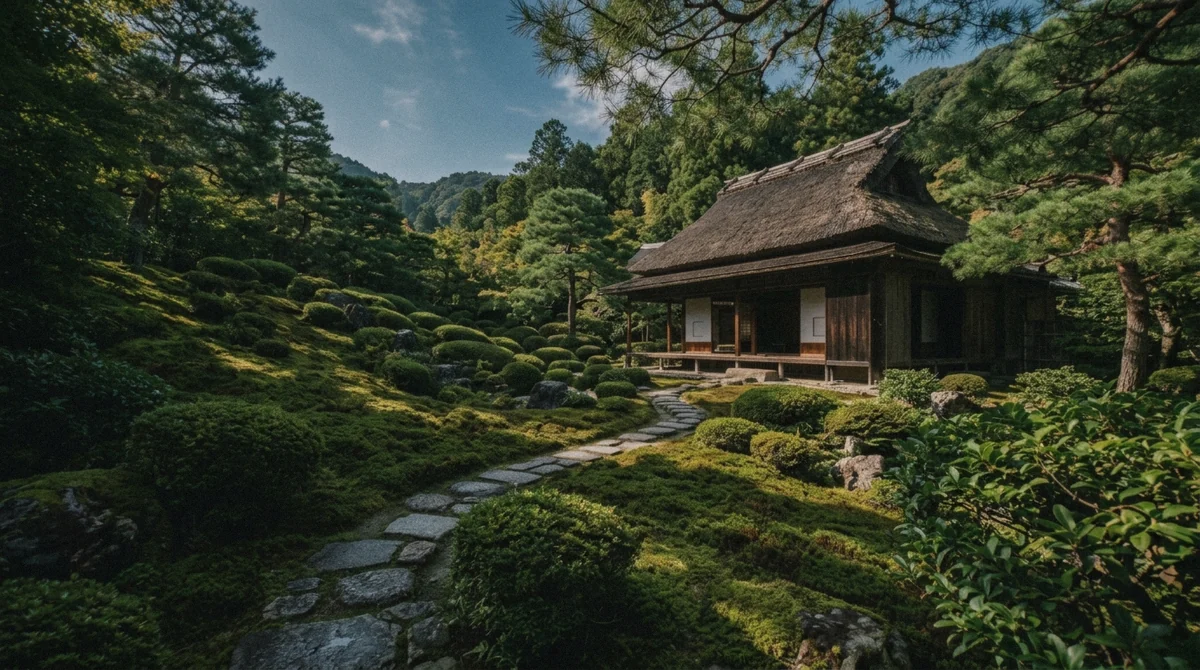
The upper garden. Thirty metres below, the bamboo path is shoulder to shoulder.
Quick answer
Okochi Sanso Villa charges ¥1,000 for adults, which includes a bowl of matcha served at the Tekisui-an teahouse, and opens 9:00 to 17:00. It was the home of the period-film actor Okochi Denjiro, who built it over roughly thirty years from the 1930s on the slopes of Mount Ogura. The circuit takes 45 minutes to an hour and gives two viewpoints, one over the Hozugawa gorge and one over the city of Kyoto.
Key takeaways
- ¥1,000 adults, about $6.40, and the matcha is included in that.
- Keep the ticket stub: it is what you hand over at the teahouse.
- Open 9:00 to 17:00, at the northern end of the bamboo path.
- 45 minutes to an hour for the full circuit including the tea.
- Two viewpoints: the gorge and the mountains, then the city.
- One guided walk includes the ticket, at $86 for five hours.
The Walk That Includes It
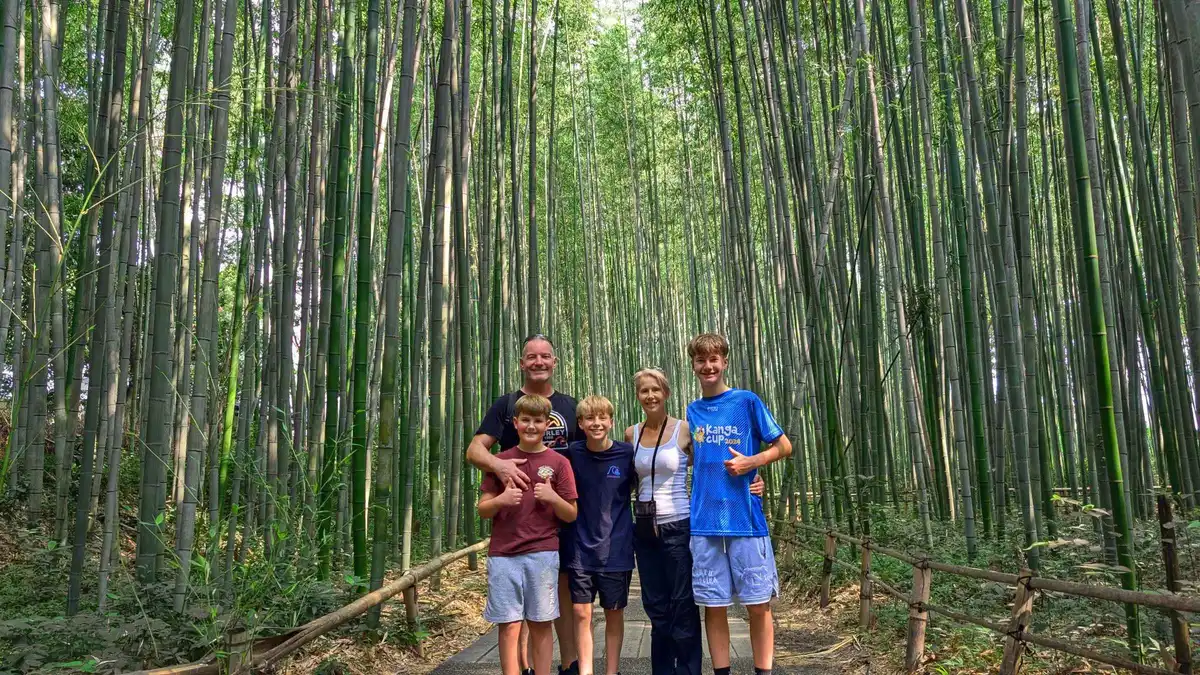
Guides mostly stop at the gate because the ticket is the most expensive entry in the district. One walk builds it in, along with the temple and the monkey park.
 from $86
Most Booked — 4.86★, 938 Reviews
from $86
Most Booked — 4.86★, 938 Reviews Arashiyama Bamboo, Temple and Okochi-Sanso Walk — with Monkey Park or Sake Brewery
The most-reviewed guided walk on this page, run by Japan Tour Adventure. It is the only one that includes the ¥1,000 Okochi-Sanso Garden ticket, and after the grove…
- Okochi-Sanso Garden entry included: the ¥1,000 villa at the top of the grove
- Tenryu-ji and Iwatayama Monkey Park tickets included (Option A)
- Option B swaps the monkeys for a local lunch and Tanzan Brewery sake tasting
- Group or private booking at different rates
 from $51
Lowest Price — 4.89★
from $51
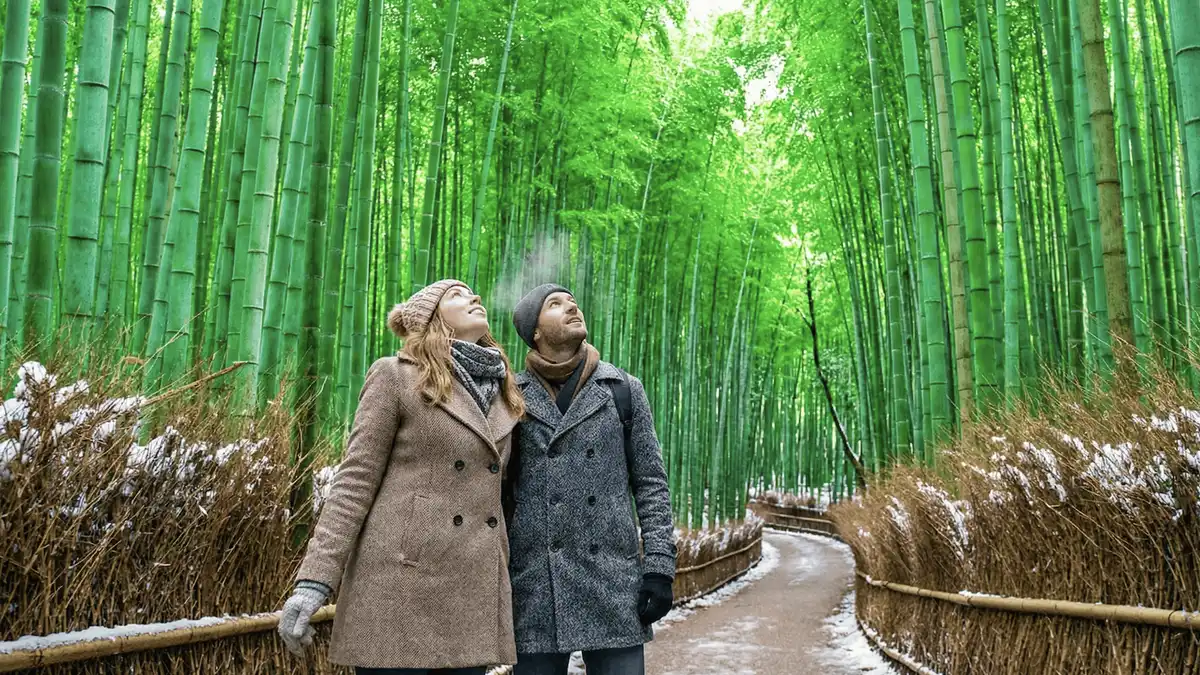
Lowest Price — 4.89★ Arashiyama Unveiled — Bamboo Grove, Tenryu-ji, Matcha and Macaques
The cheapest guided version of the classic Arashiyama circuit, and the highest-rated of the four-hour walks. Same spine as the tours above (Tenryu-ji's Zen garden, the bamboo path…
- Cheapest guided walk here that still includes Tenryu-ji and the monkey park
- One matcha drink included
- Small groups that often turn out to be near-private
- Tenryu-ji Zen garden, bamboo path, Nonomiya Shrine, Togetsukyo Bridge
What the Ticket Buys
Checked in August 2026. Dollar conversions use ¥157 to the dollar.
One price, one circuit, no options. The tea at the end is the part people remember.
| Detail | |
|---|---|
| Admission | ¥1,000 (about $6.40), adults and students |
| Included | A bowl of matcha at Tekisui-an, redeemed with your ticket stub |
| Opening hours | 9:00 to 17:00 |
| Time needed | 45 minutes to an hour |
| Where | The northern end of the bamboo path, on Mount Ogura's lower slope |
| Also on site | Open-air museum on Okochi Denjiro's film career |
A Film Star's Thirty-Year Project
Okochi Denjiro, who lived from 1898 to 1962, was the biggest name in jidaigeki, the samurai period films that carried Japanese cinema through the 1920s and 1930s. He bought this hillside and spent roughly three decades building on it, paying for the work with film money as it came in, adding a hall here and a teahouse there rather than commissioning an estate all at once.
That is why it does not read as a single design. The Daijokaku hall, the small Jibutsu-do devotional hall, the Tekisui-an teahouse and the Myoko-an all went up at different points from the 1930s onward, with the gardens planned around them and Denjiro involved throughout. Several of the buildings are now recorded as national cultural properties. When he died in 1962 the estate passed to his wife Taeka, who opened the gardens to the public, and the family still maintains it.
The circuit, in order
The path climbs from the gate through pines, reaches the Daijokaku hall, then narrows between hedges wide enough for one person at a time. That single-file stretch is deliberate and it works: it strings visitors out so the garden never feels shared.
From there you reach the first viewpoint, over the Hozugawa gorge with the Arashiyama mountains stacked behind it, then a moss garden and the teahouse, and finally a second lookout facing the city of Kyoto itself. The order matters, because the tea comes near the end when your legs have earned it.
- Daijokaku, the main hall, 1930s and 1940s construction
- The hedged single-file path, the best-designed twenty metres in Arashiyama
- The gorge viewpoint, over the Hozugawa and the mountains
- The moss garden and Tekisui-an teahouse, where the matcha is served
- The city lookout, facing east over Kyoto
- The open-air museum on Denjiro's film career
Myoko-an, and copying sutras
Off the main path is Myoko-an, a hall where the actor's wife once lived, renewed for the fiftieth anniversary of his death. It has four desks set up for shakyo, the practice of copying sutras by hand, with paper, brush and text provided.
It is quiet in a way nowhere else in Arashiyama is quiet, and hardly anybody goes in. Children under 15 are not admitted, and the hall closes on unscheduled days, so treat it as a bonus rather than a plan.
Why It Is Worth ¥1,000 When the Bamboo Is Free
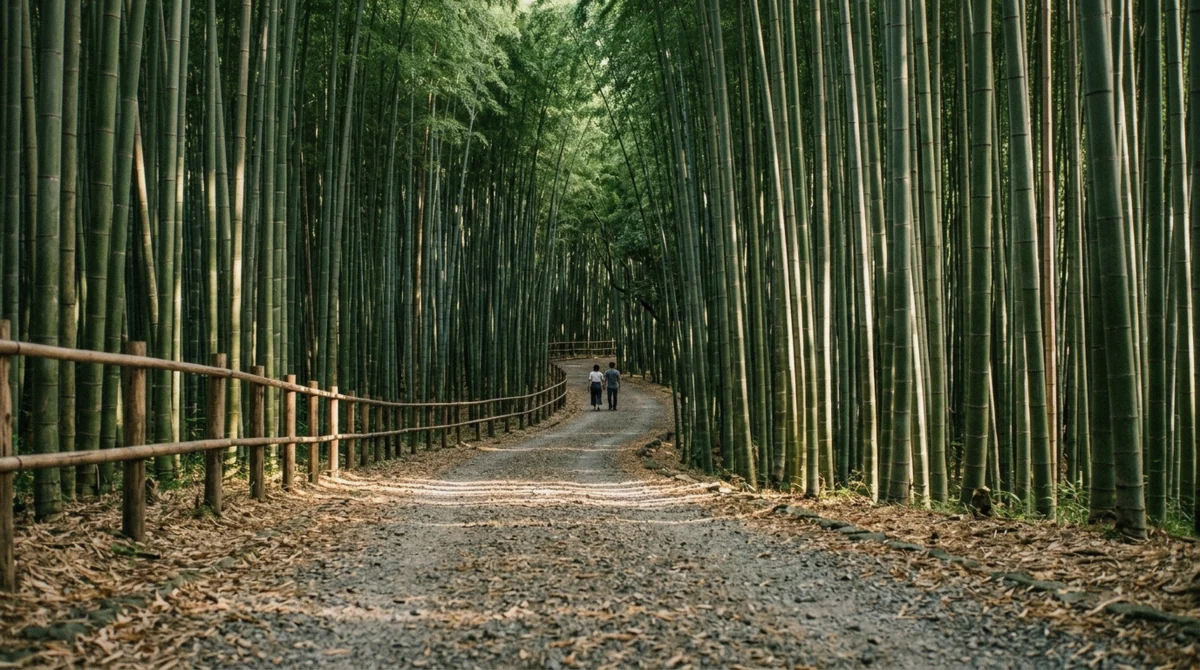
The top of the bamboo path. The villa gate is on the right, and most people turn left and go back down.
The comparison people make is with the grove, which costs nothing, and that is the wrong comparison. The right one is with an hour of your morning in a district where every free thing is crowded by 10:00.
A thousand yen here buys the only place in Arashiyama where you can sit down with a view and no queue. It also buys the view itself: the monkey park's panorama costs ¥800 plus a 160 metre climb, and this one costs ¥1,000 including a drink and thirty metres of gentle path. For anyone who is not going up Iwatayama, this is the view of the district.
When to go
Mid-morning, around 9:30 to 10:30, is the sweet spot: you have walked the bamboo early, the villa has opened, and the crowd building below has not affected anything up here because it never does.
Autumn is the peak, with maples through the upper garden and a queue at the gate for the first time in the year. Winter is the connoisseur's season, with the city view at its clearest and the moss holding frost. The gardens were planted to give each season its own reason, which is the sort of claim every Kyoto garden makes and this one earns.
Where the Gate Is
At the top of the bamboo path, facing you as you arrive. That is why it makes sense as the turning point of the walk.
Questions at the Gate
Is Okochi Sanso Villa worth visiting?
It is the best value in Arashiyama once you account for what ¥1,000 removes: the crowd. You get a hillside garden, two viewpoints, a teahouse with matcha included and about an hour that feels nothing like the path you just walked. The people who call it overpriced are comparing it with the free bamboo rather than with an hour of quiet.
What is Okochi Sanso Villa famous for?
Two things: the view over Kyoto and the Hozugawa gorge, and the man who built it. Okochi Denjiro was Japan's leading period-film actor of the 1920s and 1930s and spent about thirty years constructing the estate with his film earnings. Several of its buildings are national cultural properties.
Where is Okochi Sanso Villa?
At the northern end of the Arashiyama bamboo path, on the lower slope of Mount Ogura. Walk up through the grove from Nonomiya Shrine, or leave Tenryu-ji by its north gate and continue uphill; either way the entrance faces you at the top, about a fifteen-minute walk from the shopping street.
How much does Okochi Sanso cost and what is included?
¥1,000 for adults, which includes a bowl of matcha served at the Tekisui-an teahouse. Keep your ticket stub, because it is what you hand over for the tea. The villa's own information also lists a sweet with it, though that has varied over the years. The full district cost breakdown puts it alongside everything else here.
How long does the visit take?
Forty-five minutes to an hour for the circuit including the tea. Add twenty minutes for the open-air museum on Denjiro's films, and more if Myoko-an is open and you sit down to copy sutras. It is the one place in Arashiyama where sitting still is part of the point.
Is it accessible with a stroller or wheelchair?
Not really. The circuit climbs, the surfaces are gravel and stone, and the hedged section is single-file with steps at points. A carrier works. If mobility is a factor, the Tenryu-ji garden covers similar ground with a flatter path for half the price.
Which is better, this or the monkey park view?
The monkey park has the wider panorama and the macaques, for ¥800 plus a 160 metre climb. Okochi Sanso has the calmer view, a garden and a bowl of tea, for ¥1,000 and no real climb. If you can only do one and it is July, take this one.